


NAD M33 / M33 V2 — Is This the Best Streaming Amplifier to Date?
In case you haven’t spent all your Christmas money yet, here’s an idea: treat yourself to a grown-up music system.
A quiet revolution has been brewing in high-end audio. For decades, “serious” Hi-Fi meant towering stacks of boxes, heavy power amps, analog everything, and a stubborn refusal to embrace convenience. The scene was (and still is) ruled by names you may or may not know: Accuphase, Linn, B&W, McIntosh, Sonus Faber, Tannoy — and many more that make you wonder how on earth they still exist. Some don’t (RIP Revox). Some never quite belonged in the high-end club in the first place (looking at you, B&O — lovely design, though). And then there has always been NAD: sober, olive-green metal boxes with absolutely zero frills.
But times changed. Even audiophiles eventually discovered design. Today, elegant components combine reference-grade amplification, intelligent streaming platforms, and room-correction tech once reserved for mastering studios.
Few brands embody this shift better than NAD, and few products showcase it as convincingly as the M33 and its successor, the M33 V2. This is not a compromise device, it’s the distilled result of half a century of engineering, beginning in 1972 with a simple, rebellious idea:build audio gear that prioritizes performance, not prestige.
A Brief History of NAD: The Quiet Innovator
1972: Performance First, Ego Never
Founded in London with Canadian DNA, NAD(New Acoustic Dimension) didn’t care about champagne-gold finishes or chrome-plated ego-boosters. They cared about smart engineering, high current, and real-world use. Their amps were designed for living rooms, not laboratory benchmarks.
The NAD 3020: A Legend in Beige
In the late 70s, NAD launched the 3020 — a modest-looking integrated amp that became the best-selling amplifier in Hi-Fi history.
It was cheap. It was ugly (to most). And it was a revolution.
Its high-current design allowed it to power speakers far above its class. Students paired it with giant JBLs and KEFs while audiophiles, spending 10× more, quietly questioned their life choices.
The NAD 2200 (1984): The Power Envelope Giant
The 2200 power amp introduced NAD’s “Power Envelope” technology — capable of delivering massive bursts of dynamic power while staying cool and unflappable. Perfect for parties, studios, and anyone who wanted muscle without meltdown. Many amps today still can’t do what the2200 did effortlessly.
The Master Series & The Digital Leap
In the 2000s, NAD launched the Master Series: elegant industrial design meets advanced digital engineering. Key innovations:
- HybridDigital amplification
- MDC (Modular Design Construction) — upgradable digital boards
- BluOS — arguably the best Hi-Res streaming ecosystem available
By the 2010s, NAD quietly became one of the few brands making Class D amps that didn’t sound “digital.” Clean, transparent, powerful — without the sterility people fear.
Meet the M33.
The NAD M33 / M33 V2: A Streaming Amplifier Without Compromise
Design & First Impressions
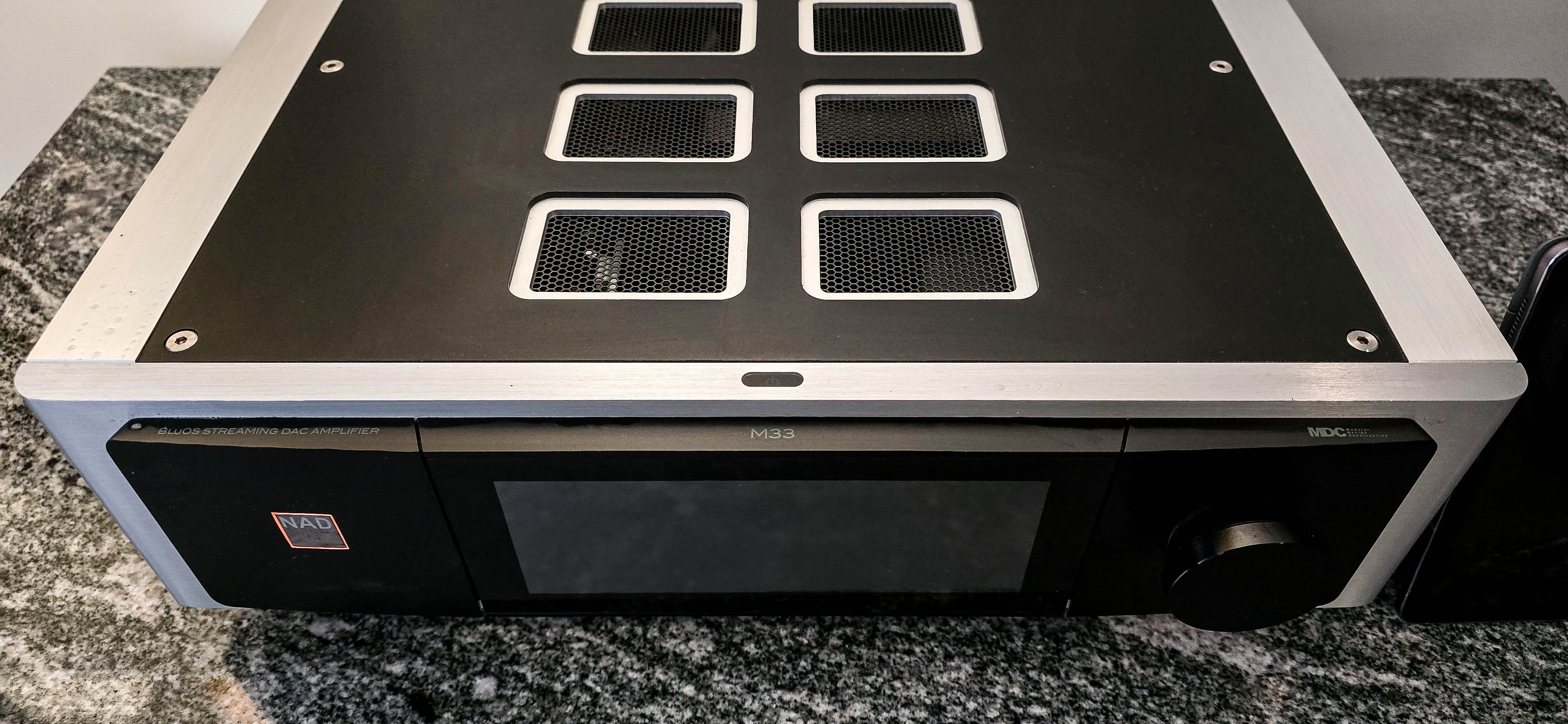
The M33 looks like it belongs in 2025: precisely milled aluminum, responsive touchscreen, Linux under the hood. Clean, minimalist, free of unnecessary gimmicks. It feels like a cross between a premium DAC, a studio tool, and a contemporary design object.
Under the Hood
BluOS: Streaming for Adults
BluOS is shockingly polished. It’s stable, integrates all major Hi-Res services, supports multi-room setups, AirPlay 2, Roon, home automation, and local NAS/USB playback. It just works — without the usual app flaws. You still can stream via Bluetooth directly from your phone, but why would you? The quality is simply lower doing that.
Purifi Eigentakt: Class D, Reborn
The M33 uses Purifi Eigentakt modules —some of the cleanest, lowest-distortion amplifier circuits ever developed.
Forget anything you think you know about Class D (assuming you knew anything).
The sound is:
- fast
- transparent
- uncolored
- astonishingly controlled
It gets out of the way and lets the music breathe. No “romantic haze.” If you want warm fuzziness, look elsewhere.
Dirac Live: Your Room, But Better
Dirac Live is the great equalizer. Most rooms are acoustic disasters — boomy bass, reflections, weird dips. Dirac measures and corrects it. The result? Balanced, coherent sound even in unruly spaces.
Fully integrated, seamless, and transformative.
MDC: Future-Proof by Design
Digital ages fast. Analog does not.
NAD’s MDC slots allow you to upgrade HDMI, interfaces, and connectivity. TheM33 V2 itself is the product of this philosophy. This is the opposite of planned obsolescence.
Connectivity & Everyday Use
The M33 is one of the most practical high-end amplifiers you can buy. It includes:
- HDMI eARC
- Analog + digital inputs
- Phono stage (your Technics SL-1200 will thank you)
- Headphone output
- aptX HD
- AirPlay 2
- Roon
- USB playback
- Multi-room support
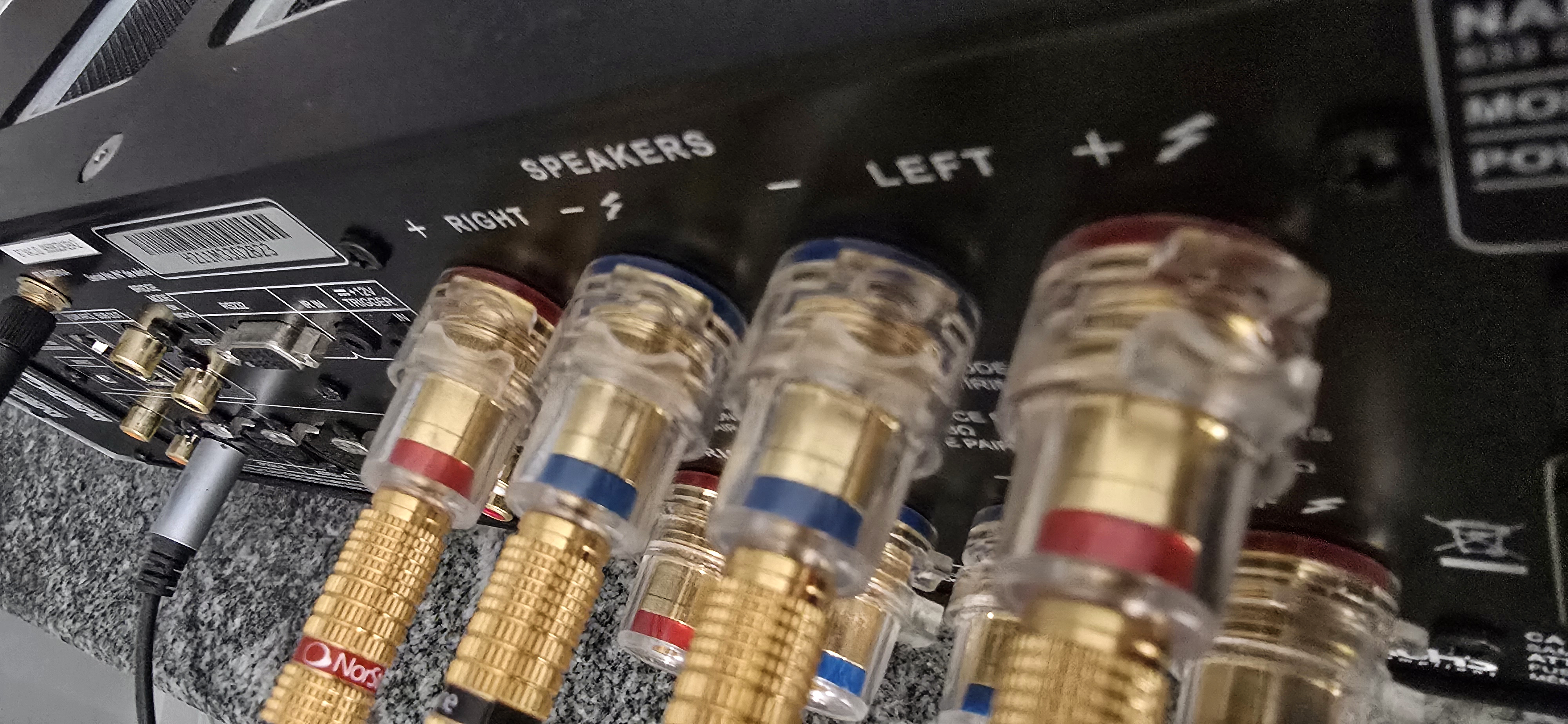
And if 2 × 380 W into 4 ohms somehow isn’t enough, you can:
- bi-amp
- tri-amp
- or run M33s in mono for ~700 W into 8 ohms
NAD famously underrates its amps, so you will never feel underpowered.
The remote? A blue-lit, milled aluminum slab heavy enough to kill a large dog.
Listening Impressions
Setup: NADM33 + Klipsch Reference RF-7 III
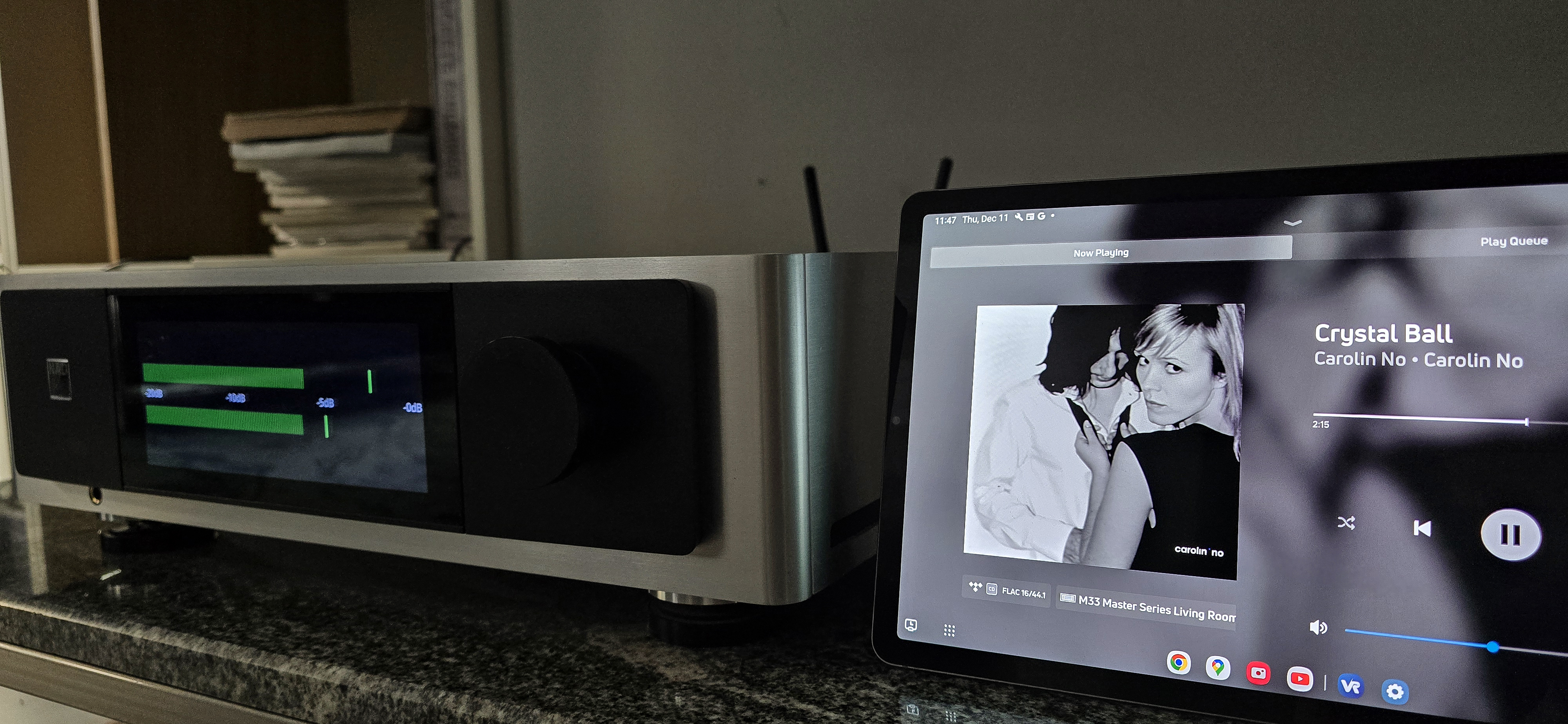
Carolin No — “Crystal Ball”
The singer’s voice appears with delicate micro-details and a beautifully natural timbre. The center image is laser-stable. The Klipsch horns + Purifi control create an almost holographic stage. Clarity without aggression, transparency without coldness.
This is Purifi + Dirac at their finest.
Dire Straits — “You and Your Friend”
Knopfler’s guitar flows like warm honey. The M33 captures decays, reverb tails, and the relaxed groove with effortless precision. Bass is firm but never bloated. The guitar tone is sweet and melancholy, presented with striking clarity but zero sharpness.
The M33 shines in midrange naturalness.
Boris Blank / Yello — “Electrified II”
The stress test. Deep, dry, tight bass. Rapid transitions. Swirling stereo effects. Not a hint of collapse when the track goes full Yello. The M33 holds everything together with surgical control.
Who Is the M33 For?
- People who want high-end sound without a stack of gear
- Or want near-reference performance with just 2–3 components
- Listeners who want streaming at the center of their system
- Fans of clean, modern design
- Audiophiles tired of cable-chasing and tweak rituals
- Anyone wanting reference performance with everyday usability
A Flagship for the Future
From the humble 3020 to the muscular 2200and now the digitally refined M33, NAD has stayed consistent: engineering over ego, performance over pomp.
The M33 isn’t just a great streaming amplifier.
It’s proof that digital high-end can be elegant, powerful, future-proof, and emotionally engaging.
A surprising side note: many younger listeners have never actually heard true lossless music. For them, “high quality” has meant MP3s, Bluetooth compression, and streaming services that quietly shave off data to save bandwidth. CD-quality? SACD? Completely foreign concepts. Which is why the first encounter with a system like the M33 and matching speakers playing Hi-Res Lossless audio at 24-bit/192 kHz, it can feel borderline shocking — as if someone finally turned the lights on in a dimly lit room they've been sitting in for years. Suddenly there’s space, texture, air, micro-details, and emotional nuance they simply didn’t know existed. It’s not nostalgia; it’s the realization that they’ve never really listened to music before — not in its full, uncompressed glory.
The M33 V2 retails for around €6000. You can add M23 power amps if you want the entire neighborhood to know your name. Is it cheap? Yes and no. You are going to need matching speakers, which add another €5000 to how much have you got? And you need quality cabling, and maybe a M23. So you are realistically looking at around €15000 to €30000, depending on the speakers and your preferences. But this setup will easily outperform systems double or triple the price.
But…
The M33 won’t satisfy purists who believe only Class A/B (preferably glowing tubes) can deliver “real” music. The M33 shows you the recording as it is. Great recordings sound divine; mediocre ones are exposed. No golden mist, no nostalgia filter.
Speaker pairing is relatively painless —the M33 can drive almost anything — but its control lets you experiment with bold choices: Klipsch La Scala, B&W 800 series, KEF Blade, Magnepan LRS+, large Tannoys, Martin Logan electrostatics, Dynaudios, and even passive studio monitors that normally shred underpowered amps.
Is there a competitor? Of course, the Hegel H390 for example. But it’s one third or so more expensive and offers less features, especially in the room correction, streaming and connectivity areas. The sound is different too, the Hegel being more voluminous, the NAD more clean. So the Hegel is maybe more a Shiraz, more volume, more warmth and it sounds a bit more indulgent, and the NAD is the Pinot Noir – more transparent, showing more clarity and finesse. So at the end it’s up to your taste, just remember, some of the world’s best Champagnes are made with Pinot Noir.
It’s early December. You can still get yourself one for Christmas if you are fast.

