



Stay smart. Stay sceptical. Stay safe.
People lie. On CVs. In job interviews. On first dates.
So of course they lie on LinkedIn. Why wouldn’t they?
Sometimes it’s harmless: inflated job titles, “strategic leadership” that mostly involved PowerPoint, a degree that sounds more impressive than it really was. Annoying, but not dangerous.
The real problem is something else entirely: fake profiles built with intent. Profiles using stolen photos. AI-generated faces. Entire careers fabricated from scratch. Not for vanity — but to extract information, money, or trust.
And yes, it works. That’s why it keeps happening.
A typical scenario starts innocently. An attractive professional. Very often a young woman, because, let’s be honest, flattery is a known weakness in social engineering, and it works particularly well on people who aren’t used to receiving it on professional platforms. Or any platform.
A polished title. “Brand Manager” here, “Project Lead” there. A connection request that feels flattering, not suspicious. Often there are already a few mutual contacts - sometimes because those accounts were compromised earlier. That’s classic social engineering.
Sometimes the person is real. Sometimes the photo comes from a model agency or an Instagram account halfway across the world. This is not hypothetical. We’ve seen it happen.
LinkedIn is one of the most powerful professional platforms on the planet, with over a billion users and tens of millions of companies. Recruiters, founders, sales teams, and executives rely on it daily. That also makes it a high-value hunting ground for scammers. Wherever trust exists, someone will try to exploit it.
The Rise of Fake LinkedIn Profiles
LinkedIn has acknowledged a steady increase in fraudulent accounts over recent years. Detection systems catch most fake profiles early - many are blocked during registration, others shortly after. That’s the good news.
The bad news? The volume keeps growing. As AI makes it easier to generate realistic photos, believable career paths, and convincing messages, the barrier to entry for scammers keeps dropping. Creating a fake identity no longer requires skill — just intent.
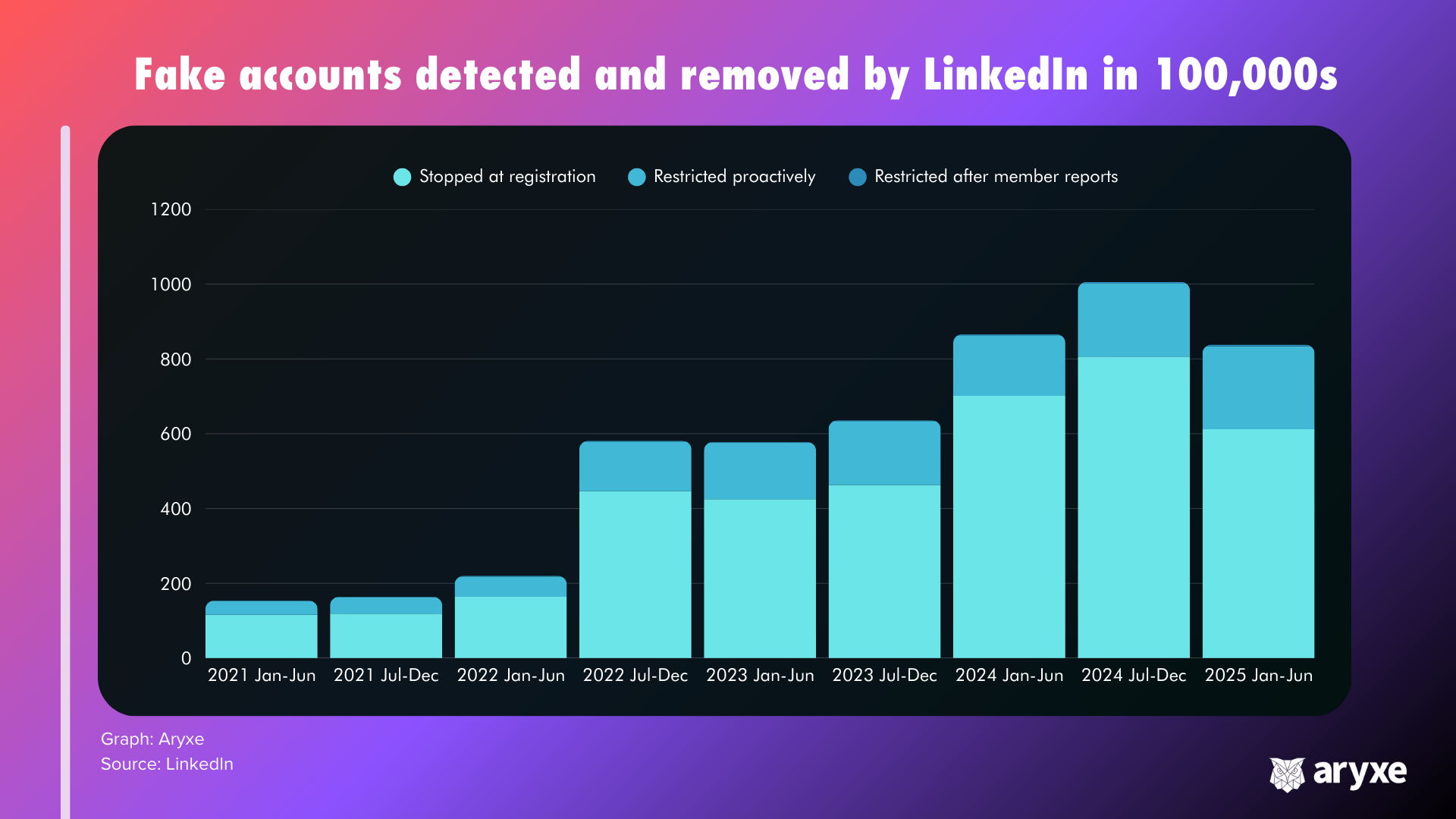
Fake profiles range from exaggerated “almost real” personas to entirely fictional people. Their goals vary:
• harvesting personal or corporate information
• running fake recruitment schemes
• pushing investment or crypto scams
• building long-term trust for later exploitation
If someone you don’t know reaches out, the assumption should not be “they’re probably legit.” It should be “prove it.”
How to Spot a Fake LinkedIn Profile
If a connection request or message feels even slightly off, slow down and check the basics. Patterns repeat - scammers are creative, but not original.
.png)
Profile picture
Be sceptical. Very sceptical.
• Stock-photo perfection or uncanny “AI smoothness” is a red flag
• Photos taken from behind, heavily filtered, or oddly cropped deserve scrutiny
• Run a reverse image search. Doen’t always help, but sometimes
If the face can’t be verified, that’s not a coincidence.
Profile information
Impressive titles are cheap. Details are not.
• Look for gaps, vague descriptions, or career timelines that don’t quite add up
• Verify companies: do they exist, and do they employ people like this?
• Real professionals leave traces - posts, comments, references, external mentions
A glossy profile with no substance underneath is suspicious by default.
Connections
Social engineering thrives on borrowed trust.
• Scammers often connect aggressively within one network to create mutual contacts
• Don’t assume a shared connection equals validation
• If in doubt, ask a mutual contact whether they actually know the person
Rapid connection growth or oddly clustered networks are warning signs.
Messages
This is where intent becomes visible.
• Conversations that quickly move toward sensitive topics should trigger alarms
• Requests for documents, credentials, or off-platform communication are classic tactics
• Links and attachments from unknown contacts should be treated as hostile until proven otherwise
You don’t owe politeness to a potential scam.
What to Do If You Suspect a Fake Profile
Don’t engage. Don’t argue. Don’t “play along.”
• Block the account
• Report it using LinkedIn’s reporting tools
• Warn relevant colleagues or mutual contacts if necessary
Preventative scepticism beats damage control every time. If you don’t know the person — and can’t verify them - don’t connect.
The Real Risks Behind Fake Profiles
This isn’t just about awkward conversations or wasted time.
Fake LinkedIn profiles are used for:
• identity theft
• phishing and credential harvesting
• financial fraud and investment scams
• reputational damage to individuals and companies
In one widely reported case, a professional connection evolved into what appeared to be a trusted friendship. Over time, the scammer introduced cryptocurrency investments, guided the victim through legitimate platforms, and then redirected funds to a fake investment site. The result: a loss of $1 million.
For businesses, the damage can be indirect but severe. Scammers may pose as employees, recruiters, or partners, using your brand to lend credibility to fake job ads or fraudulent offers. Cleaning up that mess takes time — and trust, once damaged, is hard to rebuild.
So, what should you do now?
LinkedIn is an incredibly useful platform. It creates opportunity, visibility, and connection at scale. But trust at scale attracts abuse at scale.
Being sceptical doesn’t make you rude or paranoid. It makes you realistic.
Assume nothing. Verify everything. And remember: if a profile exists only to gain your trust, that trust is exactly what you shouldn’t give.

