


.png)
Is Google Search fading—or just transforming? Discover what’s really happening to Google Search.
Over the past few months, discussions across the digital marketing world have questioned whether Google Search is “dying.” The rise of AI-driven tools like ChatGPT and Google’s own AI Overviews has accelerated the debate. While search as we’ve known it is undoubtedly changing, the evidence shows that Google remains the dominant player. The challenge for businesses is not whether Google Search will survive, but how they must adapt their advertising strategies in this new landscape.
Google Search Remains Dominant, but User Behavior Is Shifting
Despite recent chatter, Google continues to hold around 90% of the global search market—a position unmatched by competitors.
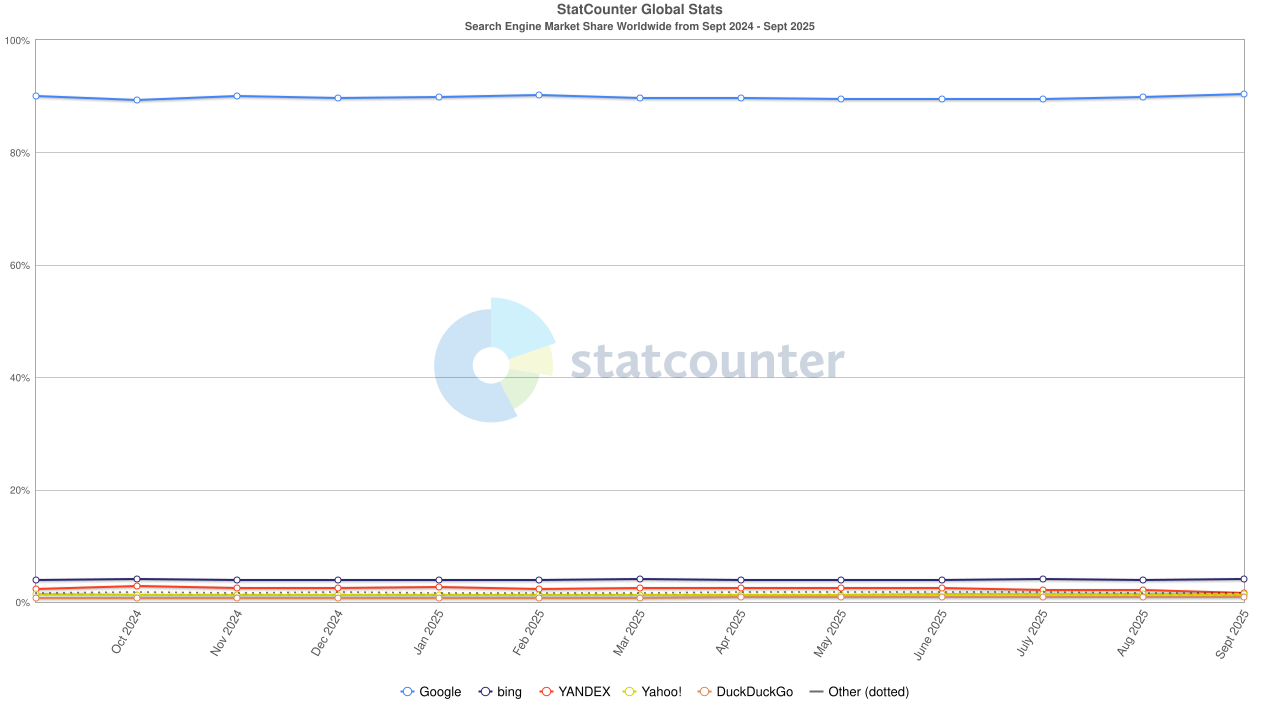
Importantly, younger demographics remain active users. Data from Morgan Stanley shows that 56% of 18–24 year olds begin their purchase journey on Google Search, YouTube, or Gemini, a share that has grown in the last year.
Comparisons with AI tools like ChatGPT highlight the scale difference: ChatGPT processes around 37 million search-like prompts per day, while Google handles more than 14 billion daily searches. Google is not disappearing, but the way people use it is evolving.
AI Overviews and AI Mode Are Changing the Nature of Search
The introduction of AI Overviews and AI Mode is one of the most significant recent changes to Google Search. Instead of conducting multiple keyword-based searches, users now ask broader, conversational questions and receive more comprehensive results in one view.
The impact on traffic is clear: Click-through rates have dropped by 20 % - 37 %
This means users often get their answers directly within Google, reducing the need to click through to external websites. For advertisers, this translates into fewer available clicks and increased competition for attention.
Rising CPCs: A Direct Consequence of Fewer Clicks
As clicks become scarcer, the cost of advertising has climbed quickly in recent months.
Industry benchmarks report:
It’s also critical tounderstand that Google Ads is more than search ads. The platformencompasses YouTube, display, shopping, and Performance Max campaigns, givingadvertisers a broad set of tools to reach customers.
o CPCs up as much as 45% in the first half of 2025 (Search Scientists)
o 87% of industries showing significant CPC growth (Wordstream)
The mechanics are simple: fewer ad placements combined with the same number of advertisers drive prices upward. Google has also confirmed plans to serve ads directly within AI Overviews, which will make those placements even more competitive.
Why Google Is Still Uniquely Positioned
Even in this changing environment, Google maintains strengths that competitors cannot replicate:
o Integration of Large Language Models (Gemini) into search, making it conversational without leaving Google’s ecosystem.
o YouTube as the world’s second-largest social platform, giving Google unmatched reach in video-driven engagement.
o Ownership of the two largest search networks: Google Search and YouTube Search.
It’s also critical to understand that Google Ads is more than search ads. The platform encompasses YouTube, display, shopping, and Performance Max campaigns, giving advertisers a broad set of tools to reach customers.
Strategic Recommendations for Businesses in 2025
To navigate this evolving environment, businesses and digital marketers should focus on the following strategies:
• Adopt a full-funnel approach: Move beyond viewing Google Ads as only search or shopping. Incorporate video, display, and emerging formats.
• Start with bottom-funnel campaigns: Prioritize search and shopping ads for immediate conversions and measurable ROI.
• Use remarketing: Engage past visitors through Demand Gen, Display, Video, and Shopping campaigns.
• Leverage AI-driven tools: Test Performance Max and AI Max campaigns, but integrate them carefully to avoid disrupting high-performing campaigns.
• Emphasize video: With YouTube and Shorts becoming increasingly influential, video should be a central part of every strategy—even for local businesses.
• Diversify beyond keywords: Conversational search is reducing the effectiveness of keyword-only approaches. Broader targeting and intent-based strategies are becoming essential.
.png)
Conclusion
So, what does this mean? The idea that Google Search is “dying” has gained attention in the past few months, but the data shows otherwise. Google remains the largest search platform by a wide margin, and its integration of AI positions it strongly for the future.
What is true is that search is changing faster than ever—click-throughs are declining, CPCs are rising, and AI is reshaping the way users find information. For businesses, success will depend on adopting a full-funnel, AI-powered, and video-centric approach to Google Ads. Those who adapt quickly will continue to thrive in the new era of search.

