


Maybe you are among the ones stranded in Dubai, Abu Dhabi or Qatar right now, or perhaps you have family or friends who are stuck. Or perhaps you’ve simply been following the news. As in Ukraine, where Russia has attacked civilians with drones for years, Iran has now also discovered the “sweet” appeal of waging war from a distance. Drones and Missiles strike airbases, but also civilian condos. The weapon of choice, increasingly, is the drone.
War has always been one of humanity’s most ruthless but effective engines of technological progress. Transport, telecommunications, space travel, chemistry, physics — the demands of conflict have repeatedly forced innovation that peacetime complacency never would. Drones are the latest chapter in that story, and it is a chapter moving unusually fast.
The irony is not lost on history: without the technological pressure of two World Wars, there would be no jet engine, and without the jet engine, no mass civilian air travel. The very industry now most disrupted by drones in the Middle East exists, in part, because of the conflicts that preceded them.
Unmanned aerial vehicles — UAVs, or drones — were originally built for military missions considered too dull, too dirty, or too dangerous for human pilots. Decades later, consumer technology made them cheap, small, and simple enough for hobbyists and filmmakers. And now, in a twist that would have seemed far-fetched ten years ago, those same consumer-grade drones are flowing back onto the battlefield — adapted, weaponised, and deployed at a scale that is reshaping how wars are fought. The circle is complete, and spinning faster than ever.
What Drones Are Actually Being Used For Today
It is easy to think of drones as either a military tool or a gadget for filming holiday footage. The reality is considerably more interesting. Over the past decade, drones have quietly embedded themselves into industries that have nothing to do with either.
In healthcare and logistics, companies like Zipline — which began delivering blood products to remote clinics in Rwanda — have shown that drones can do something no road infrastructure can: get critical supplies somewhere in minutes, regardless of terrain. Amazon and Google’s Wing are pursuing similar models for everyday delivery, and while regulatory hurdles remain, market projections point to multi-billion dollar growth in this sector within the next decade.
In agriculture, drones are replacing slow, expensive, and imprecise fieldwork. Precision spraying targets specific plants rather than blanket-treating entire fields, reducing chemical use and increasing yields. Crop monitoring from the air gives farmers a view of their land that was simply impossible before. In construction and energy, drones inspect power lines, wind turbines, and solar farms at a fraction of the cost and risk of sending human workers up to do it.
Emergency services are increasingly deploying them too: thermal cameras on drones can locate missing persons or find hotspots in wildfires far faster than ground teams. At the more experimental edge, passenger air taxis — companies like Joby Aviation, Volocopter, and China’s EHang are serious contenders — remain a longer-horizon bet, but one that major investors and governments are treating as a genuine near-future possibility.
The common thread is cost and access. The same dynamic that made drones affordable for a wedding photographer also made them available for a hospital in a country with no road network, or a farmer in a region with no crop-dusting infrastructure.
Who Makes Them: The Players That Matter
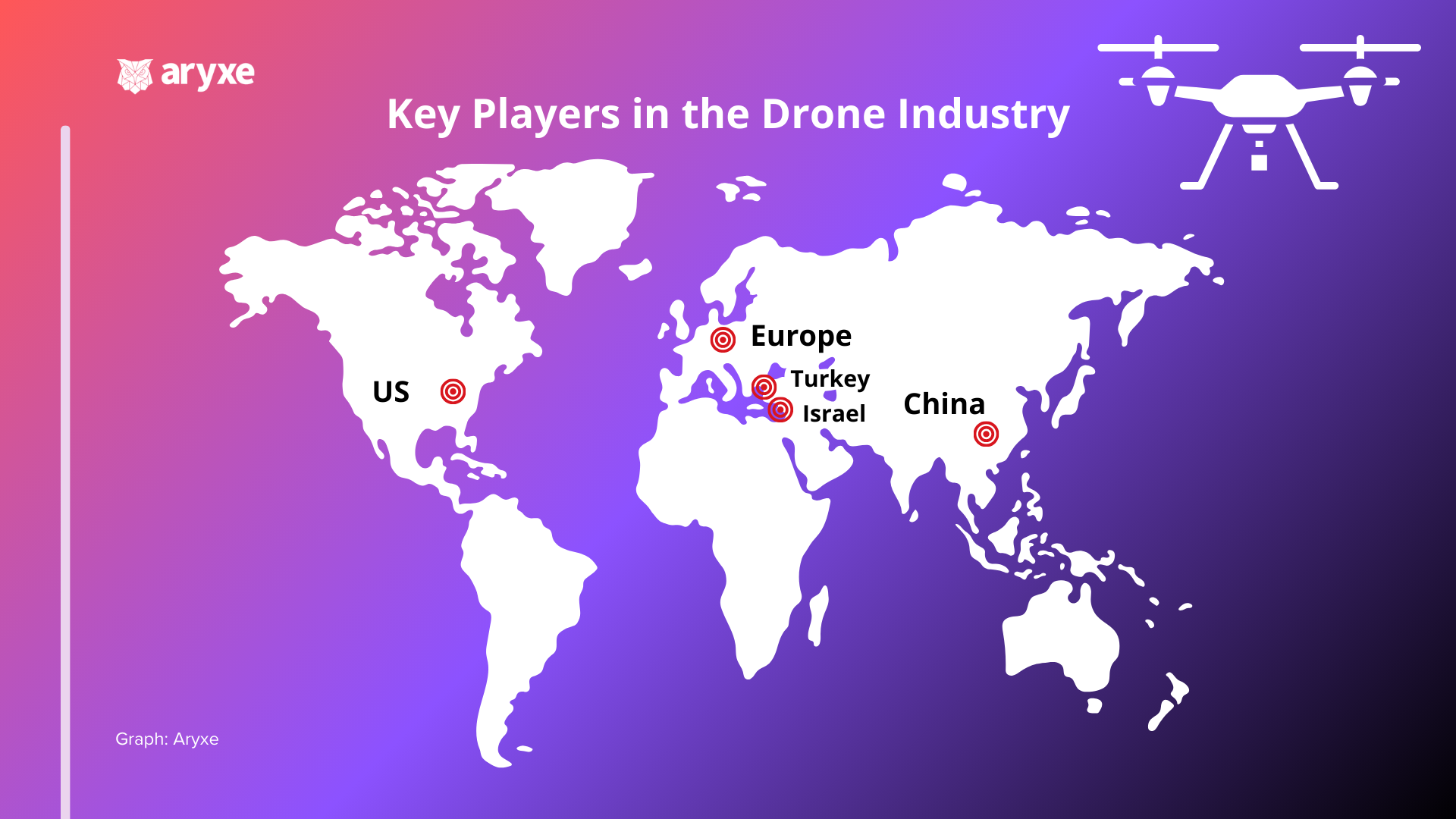
On the commercial side, the industry is dominated by two countries. China leads on manufacturing scale and price, with DJI controlling the majority of global sales of small commercial drones. The United States leads on autonomy and software, with companies like Skydio building systems capable of navigating complex environments without human input, and logistics pioneers like Zipline and Amazon Prime Air pushing the frontier of autonomous delivery.
In defence, the geography shifts. The United States has long-established players producing high-altitude surveillance and strike platforms. Israel — with companies including Elbit and IAI — has built a global reputation for intelligence and reconnaissance drones refined over decades of operational use. And Turkey has emerged as the most surprising player of the past five years: Baykar’s Bayraktar TB2 combat drone has been proven in conflicts from Libya to Nagorno-Karabakh to Ukraine, and has turned Turkey into a significant exporter of armed drones to countries that previously had no access to this class of weapon.
Below the established manufacturers, a fast-moving startup layer is developing affordable tactical systems, attack drones, and the AI software to guide them. This is where the most disruptive short-term innovation is likely to come from — and nowhere illustrates that more clearly than Ukraine.
Ukraine: The World’s Most Intense Drone Laboratory
Since Russia’s full-scale invasion in 2022, Ukraine has become something unprecedented in the history of military technology: a real-time, open-air research and development programme, with the front line as its testing ground.
What makes the Ukrainian case so remarkable is not just the scale of drone use, but the speed of innovation. In conventional defence procurement, a new system might take years to move from concept to deployment. In Ukraine, that cycle has compressed to days. Engineers, software developers, and frontline operators work together in near-real-time — a drone is tested, its weaknesses identified, modified, and redeployed within a week. There is no corporate bureaucracy, no procurement delay. There is just the immediate and brutal feedback of combat.
The resource constraints have driven the innovation just as much as the urgency. Ukraine cannot out-spend Russia, so it has had to out-improvise it. The result is a drone ecosystem built on modularity and cost-efficiency: 3D-printed components, locally assembled frames, repurposed consumer electronics. A Ukrainian FPV attack drone — essentially a racing drone fitted with an explosive payload — can cost a few hundred dollars and destroy armour worth millions.
The same logic plays out at the other end of the conflict. An Iranian Shahed drone entering UAE airspace now has to be intercepted by a Patriot missile that costs dozens of times more than the drone itself. It is one of the defining asymmetries of modern warfare: the attacker spends almost nothing, while the defender bleeds its most expensive assets. That equation is not going to resolve itself quietly.
The operational doctrine has shifted too. In most Western militaries, drones remain centralised assets controlled at a command level. Ukraine has decentralised entirely — individual units of ten soldiers run their own reconnaissance and attack drone teams, procuring hardware from civilian manufacturers outside the traditional military supply chain. NATO planners are paying very close attention.
The institutional support behind this is equally striking. The government’s Army of Drones initiative brings together over 200 manufacturers, developers, and volunteer engineering collectives. Brave1, a defence tech incubator, connects startups directly with military testing and export pathways. Companies like UKRSPEC Systems and AeroDrone began as civilian enterprises and have pivoted into defence suppliers with genuine operational track records — innovating faster, in the areas that matter most, than almost anyone else in the world.
The Risks Nobody Wants to Talk About
Drone proliferation is not without its dangers, and they go beyond the obvious concern of weaponisation.
Mass surveillance is the most immediate civilian risk. A drone equipped with a camera and connected to a facial recognition system is a tool for monitoring populations at a scale that previous generations of authoritarian governments could only dream of. This is not theoretical — it is already happening, and regulatory frameworks in most democracies are still catching up. History is consistent on one point: if something can be done technically, eventually it will be.
There is also the counter-drone arms race to consider. As drones become more prevalent, so does the technology designed to stop them: jamming systems, signal hijacking, drone-on-drone intercept platforms. These counter-drone technologies are necessary in a military context, but they do not stay in military contexts. They bleed into civilian infrastructure, disrupt legitimate operations, and create new categories of risk that regulators are only beginning to grapple with.
The regulatory picture is genuinely complex. Governments need to integrate drones safely into shared airspace, protect privacy, and prevent misuse — all without strangling an industry that holds real promise for healthcare, logistics, agriculture, and emergency response. Countries that get this balance right will have a significant advantage. Those that do not will either fall behind or face the consequences of under-regulated skies.
Where This Is All Going
The near-term trajectory is reasonably clear. More countries will scale domestic drone production, both because Ukraine demonstrated their military value and because the commercial case is becoming undeniable. Delivery networks will expand as regulations mature. Agricultural adoption will accelerate. Drone use in emergency services and industrial inspection will become standard rather than experimental.
The longer-term picture is harder to predict, but the direction of travel is not. Autonomous systems — drones that can navigate, make decisions, and operate in coordinated swarms without real-time human control — are advancing rapidly. Their implications for both commerce and warfare are profound. The question is not whether this technology will become central to how we move goods, monitor infrastructure, and fight wars. It already is. The question is who shapes it, who regulates it, and who benefits.
Ukraine offered the world an uncomfortable preview: a smaller country, outgunned and outspent, using ingenuity and cheap consumer technology to punch far above its weight. That lesson will not be lost on anyone paying attention — which, by now, is everyone.

